 By Danny DeCota
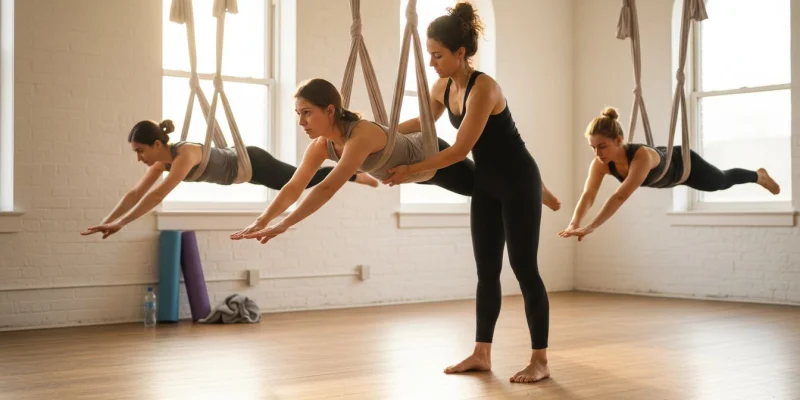
Suspension changes how the body relates to gravity. A hammock can support part of a practitioner’s weight, create traction-like sensations or make familiar yoga shapes feel entirely different. That novelty sometimes leads people to assume that every suspended position reduces spinal load, but the actual demand depends on setup, direction and muscular effort.
In a properly instructed aerial yoga class, the fabric is a tool rather than a guarantee of decompression. It can reduce load in one area while increasing the need for grip, trunk control or hip stability elsewhere. Understanding this trade-off helps practitioners use suspension with greater precision.
Spinal Load Is Not Automatically Harmful
The spine experiences load during walking, lifting, sitting and exercise. Appropriate load helps tissues adapt and maintain capacity. The goal is not to remove all force from the back.
Problems can arise when demand exceeds current tolerance, particularly when movement is unfamiliar or fatigue reduces control. Aerial practice should therefore progress from predictable supported positions towards more complex suspension.
The Hammock Changes the Direction of Force
On a mat, force usually travels between the body and floor. In aerial work, fabric may support the pelvis, thighs, hands or upper back, creating pressure from another direction.
This changes how muscles organise the body. A pose that looks similar to its floor-based version may require different stabilisation because the support can move and compress soft tissue.
Support Does Not Mean Passivity
The hammock can hold part of the body, but participants still need to manage position and balance. In a supported backbend, for example, the fabric may carry weight while the legs and trunk control rotation.
Muscular effort may be subtle rather than absent. Practitioners should avoid collapsing completely into support unless the exercise is specifically designed for passive rest.
Traction Sensations Need Context
Some suspended positions create a feeling of length through the spine. This may feel pleasant, but sensation alone does not reveal how joints or tissues are responding.
More traction is not automatically better. The practitioner should be able to enter, breathe and exit comfortably. Sharp pain, numbness or radiating symptoms are reasons to stop rather than remain longer.
Inversions Redistribute Load
In an inversion, body weight may be supported through fabric around the pelvis or legs instead of through the feet. This reduces load in some regions while creating pressure at the contact point.
The trunk and hips still work to control orientation. Inversions should be introduced gradually, with clear exit instructions. Feeling upside down can affect balance, breathing and confidence before muscular capacity becomes the limiting factor.
Trunk Control Prevents Unwanted Rotation
Because the hammock moves, small shifts can create rotation. The abdominal, back and hip muscles help the body control that movement.
This does not require maximum bracing. Excessive tension can restrict breathing and make transitions rigid. The practitioner needs enough support to manage the chosen position while remaining responsive.
Hip Strength Influences Spinal Demand
Many aerial shapes involve split stances, leg hooks or hip extension. If the hips fatigue, the practitioner may rely more heavily on the lower back or grip.
Strengthening the hips through supported lunges, bridges and controlled leg movements can improve load sharing. Flexibility alone is not sufficient when a pose requires the legs to hold or reposition the body.
Shoulder Loading Can Be Significant
Hanging, pulling and fabric-assisted planks can place substantial demand on the shoulders. The shoulder blades must move and stabilise as the arms change position.
Participants should not be pushed into full hanging before they can manage lower-load preparation. Bent arms, feet on the floor and partial weight support can create useful progressions.
Grip Fatigue Changes the Whole Strategy
When the hands tire, practitioners may raise the shoulders, hold their breath or rush transitions. These changes affect how force is transferred through the trunk and spine.
Grip demand should be distributed across the class. Resting the hands and using wraps only as instructed helps prevent fatigue from dominating every later movement.
Fabric Pressure Can Be Intense
The hammock concentrates force where it contacts the body. Pressure at the hips, thighs or upper back may feel stronger than expected even when the pose is mechanically supported.
Small changes in fabric width and placement can improve comfort. Practitioners should communicate pinching, numbness or excessive pressure rather than assuming discomfort is required.
Range Should Remain Controlled
Suspension may allow a practitioner to move farther because body weight is supported. Greater available range does not mean that the muscles can control it.
Active engagement near the edge helps maintain ownership of the position. A smaller shape with a stable exit is usually more useful than maximum depth that depends entirely on the fabric.
Entry and Exit Carry Their Own Load
The most demanding part of an aerial pose may be the transition. Stepping into the hammock, changing a wrap or returning upright requires coordination and strength.
Instructions should cover the entire route, not only the final position. Practitioners should avoid improvising a faster exit when tired or disoriented.
Tempo Influences Muscular Effort
Slow movement reduces momentum and makes changes in support easier to feel. It can also increase time under tension, creating substantial muscular demand.
Faster sequences may be appropriate for experienced groups, but speed should not replace control. The moving fabric can amplify errors in timing and balance.
Spinal Flexion and Extension Both Need Preparation
Aerial classes may include supported backbends, curled positions and rotations. No direction is universally harmful, but each should be introduced according to the participant’s experience.
The warm-up can explore smaller ranges on or near the floor. This gives practitioners a reference before the hammock adds instability or pressure.
Class Design Should Manage Cumulative Fatigue
Repeated pulling, inversions and trunk holds create a combined load. A class may feel playful while still being physically demanding.
Instructors should alternate high-demand sections with lower-load movement and rest. Practitioners also need to consider other training and recovery when choosing class frequency.
Medical Conditions Require Individual Guidance
People with certain eye, cardiovascular, neurological, joint or spinal conditions may need to avoid or modify inversions and suspension. Pregnancy and recent surgery also require individual consideration.
A general article cannot determine suitability. Participants should seek guidance from qualified healthcare professionals and inform the instructor privately about relevant restrictions.
Instruction Matters More Than Visual Ambition
When attending Yoga Edition, practitioners can choose an appropriate class level and follow the instructor’s setup and rigging rules. They should not copy an advanced wrap seen elsewhere without understanding the entry and exit.
Good instruction explains contact points, muscular purpose and safe progression. The hammock should increase learning, not pressure participants to perform dramatic shapes.
Use Suspension to Expand Options
Aerial practice can support movement, challenge stability and change how the body experiences load. Its value lies in variation, not in the claim that every position decompresses the spine.
Practitioners benefit when they recognise where the fabric carries weight and where muscles must work harder. That awareness makes suspended movement more adaptable, controlled and sustainable.
Frequently Asked Questions
Does aerial yoga decompress the spine?
Some positions may create a traction-like sensation, but load varies by setup. Aerial yoga is not a guaranteed treatment for spinal conditions.
Are aerial inversions safe for back pain?
Suitability depends on the symptoms and diagnosis. People with persistent or severe pain should seek professional guidance before attempting inversions.
Why does the hammock hurt around my hips?
Fabric concentrates pressure at contact points. Adjusting width or placement may help, but numbness, sharp pain or severe pinching should not be ignored.
Is aerial yoga easier than mat yoga?
Not necessarily. The hammock can support weight while increasing grip, balance and coordination demands.
How often should beginners attend?
One or two weekly classes may allow learning and recovery. Frequency depends on intensity, other exercise and individual response.
Can I practise aerial yoga at home?
Home suspension requires suitable equipment, verified structural support and professional installation. Improvised rigging creates serious risk.